How to Get Out of Debt Fast — Complete 2026 Guide
Getting out of debt is one of the most financially transformative things you can do. Not just because of the money you save in interest — but because of the freedom, options and peace of mind that come with a debt-free life.
But most guides on getting out of debt are vague. “Spend less, save more” is not a strategy. It is a platitude.
This guide is different. It gives you 9 specific, proven strategies to eliminate debt faster — with concrete action steps, real numbers and honest assessments of what works and what does not.
Strategy 1 — Create a Complete Debt Inventory
You cannot create an effective payoff plan without knowing exactly what you owe. This sounds obvious — but most people have only a rough idea of their total debt, and a vague sense of the interest rates involved.
Action step: Pull out every debt statement you have. Create a list with:
- Creditor name
- Current balance
- Interest rate (APR)
- Minimum monthly payment
- Payoff date at minimum payments
This inventory is the foundation of everything else. Once you see your complete debt picture in one place, you can make intelligent decisions about which strategy to apply.
Strategy 2 — Stop Creating New Debt Immediately
This seems obvious — but it is the step most people skip. While aggressively paying down existing debt, many people continue adding to it through credit card spending, buy-now-pay-later purchases or new financing.
Every dollar of new debt added while paying off existing debt extends your payoff timeline and increases your total interest cost.
Action step: For the duration of your debt payoff plan, commit to paying for everything with cash or debit. If you cannot afford it without financing, you do not buy it. This is temporary — once you are debt free, you will have the financial flexibility to make different choices.
Strategy 3 — Find Extra Money to Throw at Debt
The speed of your debt payoff is directly proportional to how much extra money you can put toward it. There are two levers: reduce expenses or increase income. The most effective approach uses both.
Reduce Expenses:
Review every recurring subscription and cancel anything non-essential. A typical person has $150 to $300 per month in subscriptions they barely use.
Review your food spending — restaurant and takeout spending is typically the largest discretionary expense category for most households. Reducing meals out from 5 times per week to 2 can save $200 to $400 per month.
Review your insurance policies — car insurance, renter/homeowner insurance, phone plans. Getting competing quotes and switching providers can save $100 to $300 per month without any change in coverage.
Increase Income:
Even $200 to $500 per month in additional income dramatically accelerates debt payoff. Options include:
Selling unused items: Most households have $500 to $2,000 worth of items sitting unused — electronics, clothing, furniture, sporting equipment. Sell them through Facebook Marketplace, eBay or local apps.
Freelance work: Offer skills you already have — writing, graphic design, bookkeeping, tutoring, data entry, social media management — on platforms like Fiverr, Upwork or TaskRabbit.
Overtime or additional shifts: If available at your current job, even 4 to 8 extra hours per week can generate $200 to $400 per month in additional debt payoff capacity.
Strategy 4 — Choose Your Payoff Method and Stick to It
Use the Debt Snowball (smallest balance first) or Debt Avalanche (highest interest first) — but choose one and apply it consistently. Switching methods midway or paying random amounts on random debts is the least effective approach.
For a complete comparison of these methods, see our guide: Debt Snowball vs Debt Avalanche — Which Method Pays Off Debt Fastest?
Strategy 5 — Negotiate Lower Interest Rates
This is one of the most underused debt reduction strategies — and one of the most effective. Many creditors will reduce your interest rate simply because you ask.
Call each credit card company and say:
“Hello, I have been a customer for [X] years and I have always paid on time. I am working hard to pay down my balance and I would like to request a lower interest rate. What is the lowest rate you can offer me?”
Many creditors will reduce rates by 3 to 8 percentage points for customers with good payment history. On a $5,000 balance at 22% APR, reducing to 15% APR saves approximately $350 per year in interest — and that is money that goes toward reducing your principal instead.
If the first representative says no, ask to speak with a supervisor or call back and speak with a different representative. Policies and individual flexibility vary significantly.
Strategy 6 — Consider Debt Consolidation
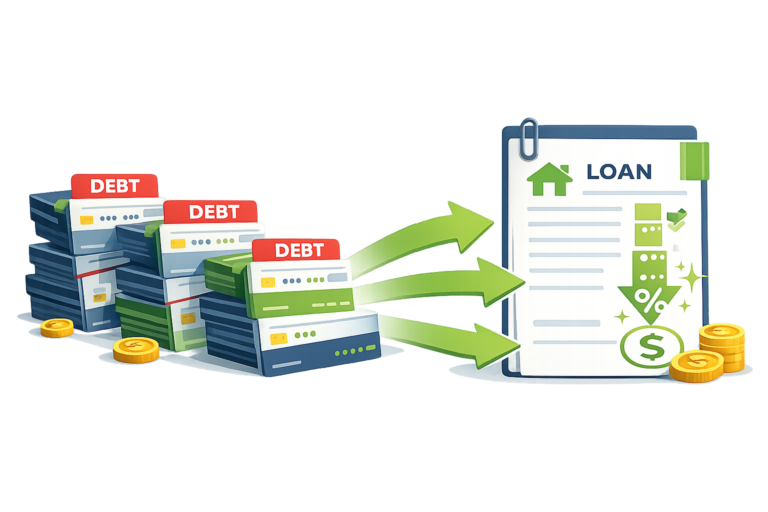
Debt consolidation means combining multiple debts into a single loan — ideally at a lower interest rate than your current weighted average rate.
When consolidation makes sense:
- You have multiple high-interest credit card balances
- You qualify for a personal loan at a lower rate than your credit cards
- You have good enough credit to qualify for a 0% balance transfer card
- Simplifying to one payment would reduce your risk of missed payments
Types of debt consolidation:
Personal debt consolidation loan: A personal loan used to pay off multiple credit card balances, leaving you with one fixed monthly payment at a (hopefully) lower interest rate. Available from banks, credit unions and online lenders. Credit unions typically offer the lowest rates.
Balance transfer credit card: Transfer high-interest credit card balances to a card with a 0% promotional APR period — typically 12 to 21 months. Powerful strategy if you can pay the balance in full before the promotional period ends. Warning: deferred interest traps exist — read the terms carefully.
Home equity loan or HELOC: If you own a home with equity, you may qualify for a home equity loan at a much lower interest rate than credit cards. Significant risk: your home is collateral — missing payments could result in foreclosure.
When consolidation does not make sense:
- Your credit score is too low to qualify for a better rate than your current debts
- You would continue accumulating new credit card debt after consolidating
- The loan fees and costs exceed the interest savings
Strategy 7 — Use Windfalls Strategically
Tax refunds, work bonuses, inheritance, insurance settlements and other unexpected money represent a powerful opportunity to dramatically accelerate debt payoff.
The temptation when a windfall arrives is to spend it on something you have been wanting. The disciplined move — if debt freedom is genuinely your goal — is to apply the entire windfall to your target debt.
A $3,000 tax refund applied to a $5,000 credit card balance at 22% APR does not just reduce your balance by $3,000 — it eliminates approximately $660 in future annual interest charges, dramatically shortening your payoff timeline.
Strategy 8 — Automate Your Payments
Every month you have to actively choose to make an extra payment is a month where you might not. Life is busy, motivation fluctuates and unexpected expenses compete for your extra dollars.
Automation removes the choice — and the temptation to redirect that money elsewhere.
Action step: Set up an automatic payment to your target debt for your extra monthly payment amount — scheduled the day after your payday. You never see the money in your account long enough to spend it on something else.
Strategy 9 — Track Your Progress Visually
Debt payoff is a marathon, not a sprint. Staying motivated over a 2 to 5 year payoff journey requires visible evidence of progress.
Create a simple debt thermometer — a visual chart showing your total debt decreasing month by month. Colour in progress each time you make a payment. Post it somewhere you see every day.
Alternatively, use a free debt tracking app like Undebt.it or Debt Payoff Planner to visualise your payoff timeline and see the impact of extra payments in real time.
Case Study — How One Couple Paid Off $67,000 in 4 Years
Marcus and Diane accumulated $67,000 in consumer debt over 8 years of marriage — credit cards, car loans and a personal loan. At minimum payments, they were looking at 22 years and $48,000 in interest to pay it all off.
They implemented every strategy in this guide:
Month 1: Created complete debt inventory — discovered they were paying $380 per month in minimum payments
Month 1: Cancelled 6 streaming subscriptions and 2 gym memberships — freed up $140/month
Month 2: Negotiated credit card rate reduction from 22% to 16% on their largest balance
Month 3: Marcus took on freelance accounting work for $800/month
Month 4: Consolidated two credit cards into one personal loan at 11% APR
Month 6: Applied $4,200 tax refund to highest-interest remaining balance
By applying all available extra money using the Debt Avalanche method, they paid off $67,000 in 48 months — paying approximately $11,000 in total interest instead of the projected $48,000.
“The first 6 months were the hardest,” Diane said. “After that we had momentum and it felt like the debt was melting. Seeing the number go from $67,000 to $50,000 to $30,000 was incredibly motivating.”
Frequently Asked Questions
How long does it realistically take to get out of debt?
At minimum payments, most credit card debt takes 10 to 25 years to pay off. With an aggressive payoff strategy applying $200 to $500 extra per month, most people can pay off $20,000 to $50,000 in debt within 3 to 6 years.
Should I build an emergency fund before paying off debt?
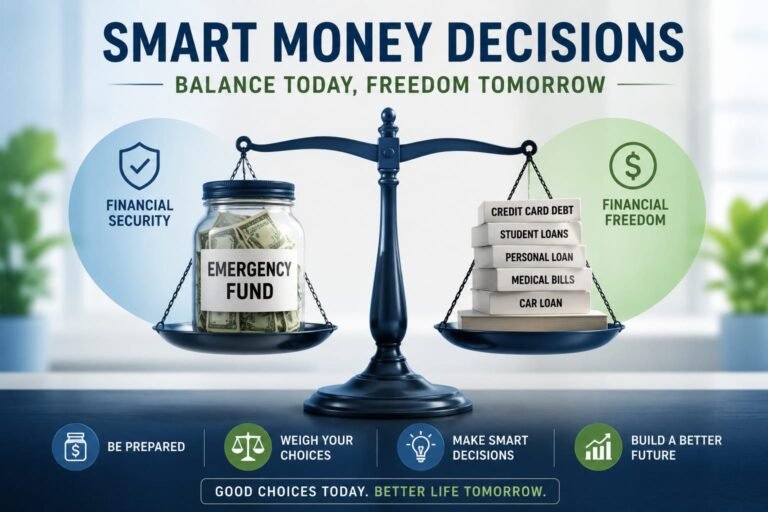
Most financial advisors recommend building a small starter emergency fund of $1,000 before aggressively paying off debt. This prevents a minor emergency from derailing your plan by forcing you back to credit cards. Once debt is paid, build a full 3 to 6 month emergency fund.
Is debt settlement a good option?
Debt settlement — negotiating with creditors to pay less than the full amount owed — severely damages your credit score and may result in tax liability on forgiven amounts. It is a last resort for people who cannot make minimum payments, not a recommended strategy for people who can afford to pay but want to pay less.
What if I cannot afford minimum payments?
Contact your creditors immediately. Many offer hardship programs — temporary reduced payments or interest rate reductions — for customers facing genuine financial hardship. For medical debt specifically, see our guides at FightMedicalBill.com on charity care and financial assistance programs.
Your Get Out of Debt Fast Action Plan — Start Today
Week 1: Create your complete debt inventory
Week 2: Calculate your total minimum payments and identify extra payment capacity
Week 2: Cancel unused subscriptions and identify one expense category to reduce
Week 3: Call your credit card companies and request lower interest rates
Week 4: Choose your payoff method and set up automatic extra payments
Remember: the fastest way to get out of debt is to start today — with whatever extra you can manage — and increase that amount consistently over time.
Financial Disclaimer: The information on DebtZeroFast.com is for educational purposes only and does not constitute financial advice. Always consult a qualified financial advisor for advice specific to your situation.
The Budget That Makes Debt Payoff Possible
Every successful debt payoff story starts with a budget. Not a restrictive, joyless budget that makes you miserable — but a purposeful spending plan that tells your money where to go before it disappears.
The Zero-Based Budget Method
The most effective budgeting approach for debt payoff is zero-based budgeting — where every dollar of your income is assigned a job before the month begins. Income minus expenses plus savings plus debt payments equals zero. Every dollar has a purpose.
How to create a zero-based budget for debt payoff:
Step 1: Calculate your total monthly take-home income — include all sources
Step 2: List all essential expenses:
- Rent or mortgage
- Utilities — electricity, gas, water, internet
- Groceries — set a specific amount, not a vague estimate
- Transportation — car payment, insurance, fuel or transit pass
- Insurance premiums — health, life, renter or homeowner
- Minimum debt payments on all accounts
- Childcare if applicable
Step 3: List all non-essential expenses and evaluate each honestly:
- Dining out and takeout
- Entertainment and streaming subscriptions
- Clothing and personal care above basics
- Gym memberships
- Hobbies
Step 4: Subtract all expenses from income. Whatever remains is your debt payoff budget.
Step 5: If the remainder is too small — go back through non-essential expenses and cut until you have a meaningful extra payment amount.
The 50/30/20 Rule Adapted for Debt Payoff
The standard 50/30/20 rule allocates 50% of income to needs, 30% to wants and 20% to savings and debt. During aggressive debt payoff, adapt this to:
- 50% to needs (essential expenses)
- 10 to 15% to wants (reduced but not eliminated)
- 35 to 40% to debt payoff and savings
This is temporary — not permanent. The restrictions of debt payoff have an end date. Maintaining some allocation to wants prevents the all-or-nothing burnout that derails many debt payoff plans.
Free Budgeting Tools for Debt Payoff
YNAB (You Need a Budget) — ynab.com: The gold standard for zero-based budgeting. Paid subscription ($14.99/month or $99/year) but frequently cited as paying for itself many times over through reduced spending. Free 34-day trial available.
Mint — mint.com: Free budgeting and expense tracking tool. Links to your bank accounts and automatically categorises spending. Good for awareness and tracking though less structured than YNAB for debt payoff.
EveryDollar — everydollar.com: Dave Ramsey’s free budgeting app, designed specifically for zero-based budgeting. The free version requires manual transaction entry — the paid version links to bank accounts.
Google Sheets: Free budget templates available through a simple search. Full control over categories and calculations without subscription fees.
How to Find Hidden Money in Your Budget
Most people are surprised by how much money is leaving their accounts without conscious decision. A thorough budget audit typically reveals $200 to $600 per month in spending that could be redirected to debt payoff without significantly impacting quality of life.
Subscription audit: Go through your bank and credit card statements for the past 3 months. List every recurring charge. Cancel anything you cannot immediately and clearly justify.
Food spending analysis: Track every food purchase — grocery, restaurant, coffee, takeout — for one month. Most people discover their food spending is 30 to 50% higher than they thought.
Insurance shopping: Get competing quotes on car insurance, homeowner or renter insurance and any other insurance policies you hold. Switching providers for the same or similar coverage regularly saves $50 to $200 per month.
Utility reduction: Call your electricity, gas and internet providers and ask about lower-cost plans or promotions. Ask specifically: “What is the lowest plan available for my usage level?” Many people are on plans significantly above their actual needs.
Staying Motivated During Long Debt Payoff Journeys
Getting out of debt fast is a relative term — for most people it still means 2 to 5 years of consistent effort. Motivation over that timeframe is not automatic. It requires systems and strategies.
Find Your Why
The most powerful motivator is a clear, specific vision of what life looks like debt free. Not vague financial security — but specific outcomes:
“When I am debt free, I will have $800 per month freed up that I currently send to creditors. I will use $400 of that to max out my retirement accounts and $400 to save for a down payment on a house within 3 years.”
Write this down. Read it when motivation fades. Specific visions are far more motivating than abstract goals.
Create Visual Progress Trackers
A debt thermometer on your refrigerator. A wall chart showing your total debt declining. A simple spreadsheet you update monthly. Visual representation of progress makes abstract numbers emotionally real.
Join a Community
Online communities like Reddit’s r/personalfinance and r/debtfree have millions of members sharing their debt payoff journeys — posting monthly updates, celebrating wins and supporting each other through difficult months. The accountability and community aspect accelerates payoff for many people.
Plan Milestone Celebrations That Do Not Involve Spending
Plan non-spending celebrations for meaningful milestones:
- First debt paid off: A favourite home-cooked meal and a movie at home
- Halfway through total debt: A day trip to somewhere you enjoy
- Final debt paid off: A meaningful experience rather than a purchase
Celebrating properly reinforces that the sacrifice was worth it and the new debt-free identity is worth protecting.
What to Do After Becoming Debt Free
Becoming debt free is the beginning of a new financial chapter — not the finish line.
Month 1 after debt freedom:
- Build your emergency fund from $1,000 to 3 to 6 months of expenses
- This prevents any future emergency from sending you back to debt
Month 2 to 6:
- Direct former debt payments into retirement accounts — maximise your employer 401(k) match first, then IRA contributions
- Start saving toward your next major financial goal — home purchase, investment account, business startup
Long term:
- Use credit strategically — for rewards and convenience, paid in full monthly
- Never carry a balance again — the interest costs are simply too high given what you know now
Your Get Out of Debt Fast — Final Action Plan
This week — Foundation:
- Create your complete debt inventory
- Set up a zero-based budget
- Cancel all non-essential subscriptions
- Set up automatic minimum payments on all debts
- Open a free Undebt.it account and enter all your debts
This month — Acceleration:
- Identify your extra income opportunities
- Call credit cards to request lower interest rates
- Apply any windfalls directly to your target debt
- Set up automated extra payment on payday
Ongoing — Consistency:
- Update your budget at the start of each month
- Update your debt tracking at the end of each month
- Increase your extra payment every time income increases
- Stay connected to your why when motivation dips
The path out of debt is clear. It requires consistent action over time — not perfection, not dramatic sacrifice, but steady purposeful effort month after month. Start today with whatever you can manage and build from there.
For strategies to deal with collectors on existing delinquent debt, see our guide: How to Negotiate With Debt Collectors — Free Scripts 2026.
Financial Disclaimer: The information on DebtZeroFast.com is for educational purposes only and does not constitute financial advice. Always consult a qualified financial advisor for advice specific to your situation.