How to Pay Off $10,000 in Debt in One Year — Step by Step Plan
Paying off $10,000 in debt in one year is an ambitious but entirely achievable goal for most people who approach it with the right plan.
The mathematics are straightforward: $10,000 divided by 12 months means you need to pay approximately $833 per month toward debt — plus interest, which means your actual payment needs to be higher to eliminate the principal completely.
This guide gives you the complete month-by-month plan — the exact budget, income strategies and expense cuts needed to make it happen — along with realistic assessments of what it actually takes and how to stay on track when motivation fades.
Is Paying Off $10,000 in One Year Realistic for You?
Before diving in, let us be honest about whether this goal is achievable based on income.
The math at different income levels (assuming 20% average interest rate):
To pay off $10,000 at 20% APR in 12 months you need to pay approximately $925 per month toward debt.
Household take-home income $3,000/month:
Required debt payment is 31% of income — very aggressive but possible with significant lifestyle adjustment
Household take-home income $4,000/month:
Required debt payment is 23% of income — aggressive but achievable with focused effort
Household take-home income $5,000+/month:
Required debt payment is 18% or less of income — very achievable with moderate sacrifice
If your income makes 23% to 31% debt payments genuinely impossible after essential expenses, consider a 18-month or 24-month payoff timeline instead. An achievable 18-month plan beats an abandoned 12-month plan every time.
The $10,000 in One Year Plan — The Numbers
Starting balance: $10,000 at 20% average APR
Target: $0 balance in 12 months
Required monthly payment: approximately $925
How to find $925 per month for debt:
Step 1 — Current minimum payments (already being paid)
Most people with $10,000 in debt are already paying $200 to $300 in minimum payments. These count toward your $925 target.
Step 2 — Expense reduction (find $200 to $300)
Subscriptions cancelled: $50 to $100/month
Dining out reduced: $100 to $200/month
Other discretionary cuts: $50 to $100/month
Total expense reduction: $200 to $400/month
Step 3 — Income increase (find $300 to $400)
This is where most debt payoff plans succeed or fail. Finding additional income is usually more powerful than cutting expenses — there is no limit to how much you can earn, but there is a floor below which you cannot cut expenses.
Income increase options:
Overtime at current job: $200 to $500/month
Freelance work (writing, design, tutoring, bookkeeping): $300 to $800/month
Gig work (delivery, rideshare, TaskRabbit): $200 to $600/month
Selling unused items: $200 to $500 one-time
Month by Month Plan:
Month 1: Create budget, cancel subscriptions, start side income, make first $925 payment
Month 2: Optimise budget, increase side income, make $925 payment
Month 3: Review progress, adjust if needed, make $925 payment
Months 4 to 11: Maintain system, apply any windfalls, make $925 payment each month
Month 12: Final payment — debt free!
Remaining balance after 12 months at $925/month from $10,000 at 20% APR: approximately $0
Total interest paid: approximately $1,100
Total paid: approximately $11,100
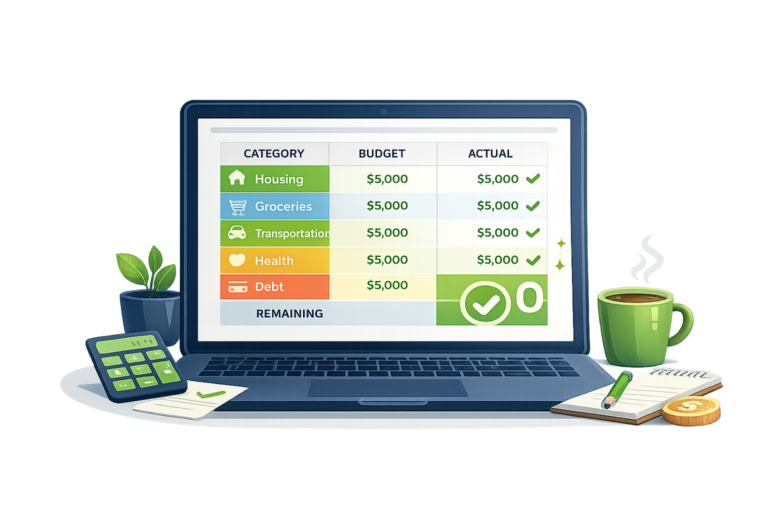
The Exact Budget You Need
Here is a sample budget for a person earning $4,000/month take-home:
Essential expenses: $2,075
Rent/mortgage: $1,200
Utilities: $150
Groceries: $300
Transportation: $300
Phone: $75
Insurance: $50
Debt payment: $925
Discretionary (what is left): $1,000 — reduced from typical spending but not eliminated
This budget requires genuine sacrifice — particularly in discretionary spending. Dining out, entertainment and shopping drop significantly for 12 months. But it is temporary. And the reward — $10,000 of debt eliminated in one year — is permanent.
The Income Acceleration Strategy — Finding Extra Money
The fastest way to pay off $10,000 in one year is not extreme frugality — it is income acceleration. Here are the most effective ways to generate an extra $300 to $800 per month:
Freelance Writing and Content Creation
If you can write clearly and research topics, freelance writing pays $15 to $100 per article depending on the platform and your experience. Platforms like Upwork, Fiverr and ProBlogger job board connect writers with clients. Even at $25 per article, writing 4 articles per week generates $400 per month.
Online Tutoring
If you have expertise in any academic subject — mathematics, science, English, history, a foreign language — online tutoring pays $15 to $60 per hour. Platforms like Tutor.com, Wyzant and Varsity Tutors connect tutors with students. 8 hours per week at $25/hour generates $800/month.
Delivery and Gig Work
DoorDash, Uber Eats, Instacart, Amazon Flex and similar platforms allow flexible earning during evenings and weekends. Most drivers earn $15 to $25 per hour including tips. 20 hours per week generates $300 to $500/month.
Selling Unused Items
Walk through your home and identify items you have not used in the past 12 months. Most households have $500 to $2,000 worth of sellable items — electronics, clothing, furniture, sporting equipment, books and collectibles. Sell through Facebook Marketplace, eBay, Poshmark or Craigslist. This is a one-time boost but can significantly reduce your remaining debt balance early in the plan.
Overtime at Your Current Job
If available, even 4 hours of overtime per week at time-and-a-half generates $200 to $400 extra per month depending on your base rate. This is the simplest option — no new skills required, income starts immediately.
The Windfalls Strategy — Applying Unexpected Money
Every windfall during your 12-month payoff year should go directly to debt — not to spending. This is where most plans either accelerate dramatically or stall.
Expected windfalls this year:
Tax refund: The average US tax refund is approximately $3,000. Applied directly to your $10,000 debt, this single windfall reduces your remaining balance by 30% — dramatically reducing the monthly payment needed for the remaining months.
Work bonus: If you receive any performance bonus, apply it entirely to debt.
Birthday or holiday money: Apply to debt rather than spending.
A single $3,000 tax refund applied in month 3 of your plan changes your payoff timeline significantly — reducing remaining payments from $925 to approximately $670 per month for the remaining 9 months.
Staying On Track — Month by Month Checkpoints
Month 1 Checkpoint: Did you make your first full $925 payment? Did you identify your extra income source? Is your budget in place?
Month 3 Checkpoint: Is your extra income materialising as expected? Have you applied any windfalls? Is your balance declining on schedule?
Month 6 Checkpoint: You should have approximately $4,500 to $5,500 remaining. How does that feel? Is the progress motivating you? Do you need to adjust your income or expense strategy?
Month 9 Checkpoint: You should have approximately $1,800 to $2,800 remaining. The finish line is visible. Increase payments if possible to end earlier.
Month 12: Zero. You are done.
What to Do When You Fall Behind
Missing a month happens. Life intervenes — an unexpected expense, a slow month for side income, a personal crisis. The key is what you do next.
Do not abandon the plan: One missed month does not ruin a 12-month plan. It extends the timeline slightly. Adjust and continue.
Double up if possible: If you miss one month and can afford to pay extra the following month, do so.
Adjust the timeline: If circumstances have genuinely changed — income reduction, new expense — revise your plan to 15 or 18 months rather than abandoning it entirely.
Case Study — How Alex Paid Off $10,200 in 11 Months
Alex, a 29-year-old marketing coordinator earning $3,800/month take-home, had $10,200 in credit card debt across two cards at average 22% APR.
His plan:
- Cancelled Netflix, Spotify, gym membership, gaming subscription: saved $87/month
- Reduced dining out from 4x/week to 1x/week: saved $220/month
- Started tutoring high school students in English on weekends: earned $480/month
- Applied his $2,800 tax refund in month 3 entirely to debt
Month by month results:
Month 1: Paid $787 (existing minimums $300 + extra $487) — balance: $9,597
Month 2: Paid $900 — balance: $8,847
Month 3: Paid $900 + $2,800 tax refund = $3,700 total — balance: $5,318
Months 4–11: Paid $750 average per month
Result: $10,200 paid off in 11 months. Total interest paid: $1,340.
“The tutoring income was the game changer,” Alex said. “Cutting subscriptions saved $87/month but tutoring added $480. Income beats frugality every time.”
The Psychology of a One-Year Debt Payoff — Staying Motivated
Twelve months is a long time to maintain financial discipline. Understanding the psychological challenges in advance helps you prepare for them.
The Motivation Curve
Month 1 to 2 — High energy: New plan, clear goal, excited. This is the easiest phase.
Month 3 to 5 — First plateau: Progress is happening but feels slow. The initial excitement has faded. This is where many people give up.
Month 6 — Halfway point: Seeing $5,000 remaining when you started at $10,000 is genuinely motivating. The halfway point often re-energises commitment.
Month 7 to 10 — Building momentum: The balance is dropping faster as more of each payment hits principal. Motivation grows with visible progress.
Month 11 to 12 — Sprint to the finish: The end is near. Many people find surprising reserves of motivation in the final stretch.
Preparing for Month 3 to 5
This is statistically the most likely dropout period. Prepare for it in advance:
Write your why: Before starting, write a detailed description of what debt freedom means to you — specific outcomes, specific feelings, specific changes. Read it when motivation fades in months 3 to 5.
Plan a non-spending reward for month 6: A weekend camping trip, a day at a park, a favourite home-cooked meal with friends. Something to look forward to at the halfway point.
Find an accountability partner: Tell someone about your goal. Check in monthly. Public commitment increases follow-through.
Track visually: A simple chart on your refrigerator showing the balance dropping month by month is more motivating than any app.
Dealing With Social Pressure
Twelve months of financial discipline means saying no to things — restaurants, trips, events, gifts you cannot afford. This creates social pressure that derails many debt payoff plans.
Prepare honest but brief responses:
“I am focused on paying off some debt right now — can we do something that doesn’t cost much?”
“I am on a tight budget for a while — I am happy to join you for the free part.”
“I’m working toward a financial goal this year — rain check?”
True friends will respect your commitment. And most social activities have lower-cost alternatives that are equally enjoyable.
What To Do After Paying Off the $10,000
Becoming debt free is the beginning of a new financial chapter. Do not let lifestyle inflation immediately consume what you freed up.
Month 1 after payoff:
- Build emergency fund: Redirect the $925/month to savings until you have 3 to 6 months of expenses saved. This prevents future debt accumulation from unexpected expenses.
Month 2 to 6:
- Invest: Once the emergency fund is complete, redirect to retirement accounts. If your employer offers a 401(k) match, contribute at least enough to get the full match — this is an immediate 50 to 100% return on investment.
Long term:
- Keep one credit card for convenience and rewards — paid in full every month.
- Never carry a balance again.
- Treat the $925/month you were spending on debt as permanently allocated to wealth building.
The most common post-debt mistake: lifestyle inflation. People pay off $10,000 in debt then immediately finance a new car, take on a large purchase on credit or gradually let credit card balances creep back up. The financial freedom of being debt free is infinitely more valuable than any purchase. Protect it.
Frequently Asked Questions
Is paying off $10,000 in one year possible on a low income?
It depends on your specific income and expense situation. On a $2,500/month take-home income, dedicating $925 to debt (37% of income) may leave insufficient money for essential expenses. In this case, a realistic 18 to 24 month plan is a better target. On $3,500+/month, a 12-month plan becomes genuinely achievable with discipline.
Should I use savings to pay off debt faster?
If you have savings earning 2 to 4% interest and credit card debt at 20% APR, using savings to pay off high-interest debt is mathematically sound. However, keep at least $1,000 in savings as an emergency buffer — otherwise you risk running straight back to credit cards for the first unexpected expense.
What if interest rates change on my variable rate cards?
Variable rate credit cards can have their rates changed by the issuer — particularly if you miss a payment (triggering penalty APR). Protect yourself by never missing a payment and requesting rate reductions from your issuers early in your payoff plan.
Can I pause the plan if I need money for something else?
Yes — but be strategic. True emergencies (medical, job loss, essential car repair) justify pausing. Wants disguised as needs (new phone, vacation, furniture upgrade) do not. Define in advance what qualifies as a genuine pause-worthy emergency.
Your Complete $10,000 in One Year Action Plan
Week 1:
- Calculate exact balance and average interest rate
- Set up a zero-based monthly budget
- Cancel all non-essential subscriptions
- Identify your primary extra income source
- Make your first extra payment this month
Month 1:
- Start side income — even if small, start immediately
- Set up automatic minimum payments on all debts
- Set up automatic extra payment on target debt on payday
- Track your starting balance and set monthly targets
Ongoing monthly:
- Update balance tracker at end of each month
- Apply any windfalls directly to debt
- Increase payment whenever income increases
- Check in with accountability partner monthly
Financial Disclaimer: The information on DebtZeroFast.com is for educational purposes only and does not constitute financial advice. Results vary significantly based on individual income, expenses and circumstances. Always consult a qualified financial advisor for personalised advice.