How to Pay Off Credit Card Debt Fast: Proven Strategies That Actually Work
Credit card debt is among the most expensive debt most people carry, with interest rates typically ranging from 18 to 30 percent annually in 2026. At these rates, minimum payments barely cover the interest charges — a $5,000 balance at 24 percent interest with minimum payments takes approximately 17 years to repay and costs nearly $8,000 in interest. The good news is that with intentional strategy and consistent execution, credit card debt can be eliminated far faster than the minimum payment treadmill suggests. This guide covers every proven strategy for accelerating credit card debt payoff.
Disclaimer: This content is for educational purposes only. Financial decisions should be made based on your complete individual situation. Consult a qualified financial advisor for personalized advice.
The Mathematics of the Minimum Payment Trap
Understanding exactly how expensive minimum payments are is essential motivation for the effort required to pay off credit card debt faster. Most credit card minimum payments are calculated as approximately 2 percent of your outstanding balance or a flat minimum of $25 to $35, whichever is greater. At this rate, the majority of your minimum payment goes directly to interest charges, leaving only a small fraction actually reducing your principal balance.
Consider a $10,000 credit card balance at 22 percent interest with a minimum payment starting around $200. Paying only minimums, this balance takes approximately 30 years to repay and costs over $16,000 in interest — meaning you pay more than twice the original balance. Increasing the payment to $300 per month reduces the payoff to approximately 4.5 years and reduces total interest to approximately $6,000. Increasing to $500 per month reduces payoff to approximately 2.5 years and total interest to approximately $3,000. The math makes clear that even modest increases above the minimum create dramatic improvements in outcomes.
For the framework to prioritize which cards to attack first, read our guide on Debt Snowball vs Debt Avalanche.
Strategy 1 — The Debt Avalanche Method
The debt avalanche method is mathematically optimal for minimizing total interest paid. List all your credit cards from highest to lowest interest rate, regardless of balance size. Make minimum payments on all cards. Direct every additional dollar above minimums to the highest interest rate card first. When that card is paid off, roll its entire payment to the next highest rate card.
Example: You have three cards — Card A at 26% with $2,000 balance, Card B at 22% with $5,000 balance, Card C at 18% with $3,000 balance. You pay minimums on B and C and attack A first with all extra money. When A is paid off, roll its payment to B. When B is paid off, roll everything to C. This approach minimizes the total interest you pay across all three cards, saving hundreds to thousands compared to random or minimum-only payment approaches.
Strategy 2 — The Balance Transfer Card
A balance transfer credit card moves your high-interest balance to a new card offering 0 percent APR for a promotional period, typically 12 to 21 months. During this period, every dollar you pay reduces your principal with zero interest charges — dramatically accelerating your payoff.
For example, if you transfer a $6,000 balance at 24 percent to a card with 0 percent APR for 18 months and pay $333 per month, you eliminate the entire balance before the promotional period ends — paying zero interest versus approximately $1,400 in interest at 24 percent over the same period.
Important considerations: Balance transfers typically carry a fee of 3 to 5 percent of the transferred amount. This fee is usually still a net savings versus continued high-interest payments. You must have sufficient credit score to qualify for a balance transfer card. You must have a plan to pay off the balance before the promotional period ends — the rate after the promotional period is often as high or higher than your current rate. Do not continue spending on either the old or new card during the payoff period.
Strategy 3 — Personal Loan Consolidation
A personal debt consolidation loan replaces multiple high-interest credit card balances with a single loan at a lower interest rate. If you qualify for a personal loan at 12 to 15 percent versus credit cards at 22 to 26 percent, the interest savings can be substantial.
The consolidation loan also converts variable-rate revolving debt to a fixed-rate installment loan with a defined payoff date — structurally forcing debt elimination rather than allowing minimum payments indefinitely. The key to making this strategy work is closing or not using the credit cards after consolidation. Many people consolidate and then run their cards back up, resulting in both the consolidation loan and new card balances.
To qualify for competitive consolidation loan rates, you typically need a credit score of 680 or higher and verifiable income. LendingTree, Credible, and SoFi are worth comparing for personal loan rates.
Strategy 4 — The Expense Audit — Finding Hidden Payment Money
Most people have more room in their budget for accelerated debt payments than they initially believe. A systematic expense audit often reveals significant opportunities to redirect money toward debt without a dramatic lifestyle change.
Review every monthly subscription and recurring charge — streaming services, apps, gym memberships, subscription boxes, insurance policies. Cancel everything you use less than weekly. Research whether you can reduce major fixed expenses — can you negotiate your insurance rates, refinance your auto loan, reduce your phone plan, or shop your internet service? Look for discretionary spending patterns — dining out, retail purchases, entertainment — where modest reductions create significant monthly savings.
A thorough expense audit typically identifies $200 to $500 per month in potential reductions without meaningful lifestyle impact. Every dollar found goes directly to accelerating your credit card payoff. For integrating this into a complete payoff plan, see our guide on How to Create a Debt Payoff Plan That Actually Works.
Strategy 5 — Income Acceleration — The Fastest Path
While expense reduction finds money that already exists in your budget, income acceleration creates new money specifically for debt elimination. Even a temporary increase in income targeted entirely at credit card debt can eliminate years from your payoff timeline.
Effective income acceleration approaches include freelancing in your professional skill area, selling unused items around your home, driving for rideshare services on weekends, taking on overtime hours if available, or starting a small side business. Committing 100 percent of all additional income to credit card debt — before it gets absorbed into general spending — is the key discipline that makes this strategy work. Adding $400 per month from a side hustle to an existing $300 minimum payment creates a $700 monthly payment that dramatically compresses your payoff timeline.
Strategy 6 — Negotiating Interest Rate Reductions
Many people do not realize they can request interest rate reductions directly from their credit card company. If you have been a customer for several years and have maintained relatively consistent payments, a hardship interest rate reduction request has a meaningful chance of success.
Call the number on the back of your card and ask to speak with the retention or account services department. Explain that you are working to pay down your balance but the current interest rate is making it very difficult, and ask if any rate reduction is available. Mention competitor offers if you have received any. Even a 5 to 6 percent reduction makes a meaningful difference over an extended payoff period. Read our guide on How to Negotiate With Creditors for complete scripts and strategies.
Strategy 7 — Automating Your Extra Payments
One of the most important and most overlooked aspects of credit card payoff acceleration is automation. Setting up automatic extra payments removes the monthly decision point and prevents extra money from being spent elsewhere before the payment is made.
Set up automatic payments for your target payoff card at your decided monthly amount — not just the minimum. Set the payment date to 2 to 3 days after your paycheck arrives. This automation ensures the debt payment happens first, before discretionary spending decisions compete for the same money.
Avoiding Common Payoff Mistakes
Continuing to use the card you are paying off is the most common mistake — every new purchase extends your payoff timeline and adds interest. Either stop using the card entirely or freeze it in a drawer. Missing the promotional period end date on a balance transfer card and being surprised by high interest charges on the remaining balance. Not having a small emergency fund before aggressively paying credit cards — one unexpected expense forces you back into credit card spending, undoing progress.
Tracking Progress and Maintaining Momentum
Tracking your balance reduction monthly provides the psychological reinforcement necessary to maintain the discipline required for successful credit card payoff. Create a simple spreadsheet or use a free app like Undebt.it to visualize your progress. Seeing your balance decline month after month, and seeing the projected payoff date move closer, provides genuine motivation to maintain the behaviors driving the progress.
Celebrate meaningful milestones — paying off the first card, reaching the halfway point of your total balance, achieving a year of consistent extra payments. These celebrations reinforce the behaviors without undermining the financial progress.
Frequently Asked Questions
Should I close credit cards after paying them off? Generally no. Closing cards reduces your total available credit, which increases your credit utilization ratio and can lower your credit score. Keep paid-off cards open but unused, or use them for small monthly purchases and pay in full.
Is it better to pay off credit cards or invest? For credit cards at typical rates of 18 to 26 percent, paying off the debt is almost always the better financial decision — it is a guaranteed return equal to the interest rate. The exception is not contributing enough to get employer 401k matching — that match is an immediate 50 to 100 percent return that typically outweighs even high-interest debt payoff.
What if I cannot afford more than the minimum payment? Start with the expense audit to find additional money. Consider income acceleration options. Contact a nonprofit credit counselor for a Debt Management Plan, which may reduce your interest rates to 6 to 10 percent through a formal creditor agreement.
Conclusion
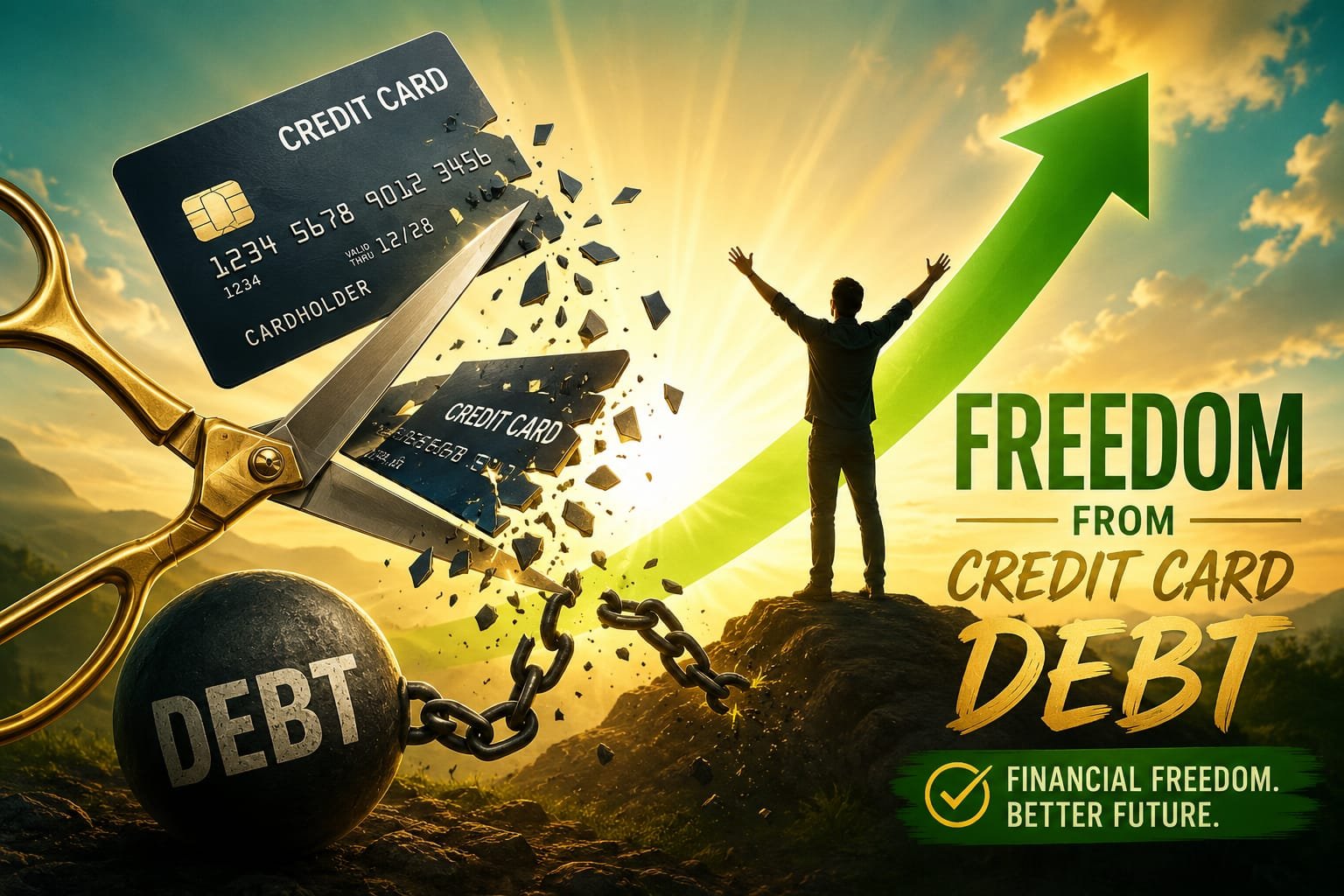
Credit card debt is beatable with intentional strategy and consistent execution. Stop paying only minimums. Choose the debt avalanche method for mathematical efficiency, consider a balance transfer card for the highest-rate balances, conduct a thorough expense audit, explore income acceleration options, and automate your extra payments. Build your complete debt elimination plan with our guides on Debt Snowball vs Debt Avalanche and How to Create a Debt Payoff Plan That Actually Works.