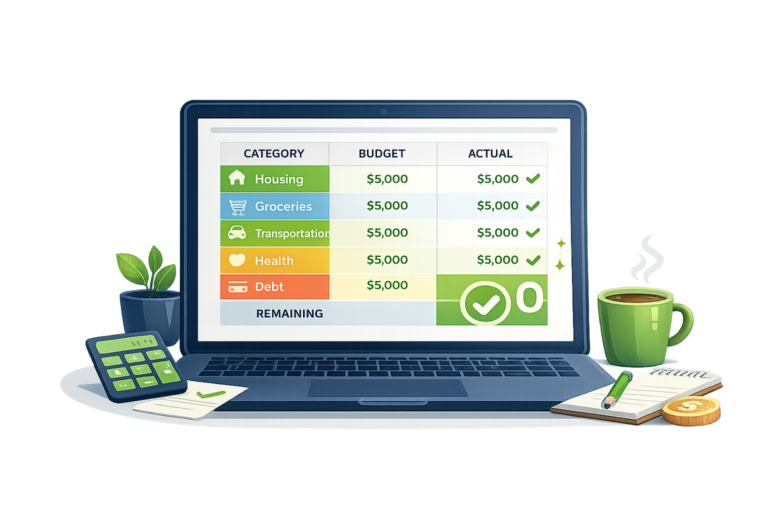

Zero-Based Budget Template Free Download 2026
Most budgets fail because they track spending after the fact. You look at where your money went, feel vague regret, and promise to do better next month. The zero-based budget solves this problem by assigning every dollar a specific job before the month begins. You decide in advance what each dollar will do — and then you make it happen.
This approach was formalized by Dave Ramsey and has helped millions of people take control of their finances. Here is how it works, how to build yours from scratch, and a complete template you can use starting today.
The Core Principle: Income Minus Expenses Equals Zero
Zero-based budgeting does not mean you spend everything you earn. It means that every dollar is assigned a category — including savings and debt payoff — so that when you subtract all assignments from your income, the result is zero. The money is not unaccounted for. It has a job. Some of it goes to groceries, some to rent, some to savings, some to your emergency fund. All of it is deliberate.
This matters because unassigned money disappears. If you have $300 at the end of the month with no plan for it, it will get spent on things you cannot name when you look back. Assign it a category — even if that category is “fun money” — and you retain control of whether you spend it or save it.
Step One: Calculate Your True Take-Home Income
Start with what actually hits your bank account each month after taxes, health insurance, and any other automatic deductions. If your income is irregular — freelance, commission, tips, hourly with variable hours — use a conservative estimate based on your lowest recent month. You can always give extra money a job mid-month if you earn more than expected. You cannot take back money you have already committed if you earn less.
Include all income sources: primary job, side income, rental income, child support received, and any other regular cash inflows.
Step Two: List Every Expense Category
Work through your expenses in priority order. Start with the categories that keep your life functioning, then debts, then savings, then wants.
Housing: Rent or mortgage, renter’s insurance or homeowner’s insurance. These are non-negotiable.
Utilities: Electricity, gas, water, internet, phone. Note that some utilities vary by season — budget higher in months when heating or cooling is heavy.
Food: Separate groceries from dining out. Groceries are a need; restaurant spending is a want. Knowing the difference clarifies where cuts can happen if needed.
Transportation: Car payment, gas, insurance, public transit, parking. Also budget for irregular but predictable costs like oil changes and registration fees by dividing the annual cost by 12 and assigning that monthly amount to a sinking fund.
Healthcare: Insurance premiums not covered by payroll deduction, prescriptions, copays. Again, use a monthly average for irregular expenses.
Minimum debt payments: Every debt has a minimum. Budget all minimums before assigning any extra payments.
Savings: Emergency fund contributions, retirement, and any other savings goals. Treat savings as a fixed expense, not what is left over.
Extra debt payment: After all essentials and minimums, assign extra to your target debt.
Personal and discretionary: Clothing, subscriptions, entertainment, dining, haircuts, gifts, and everything else.
Sample Zero-Based Budget: $4,200 Monthly Take-Home
- Rent: $1,250
- Electric and gas: $120
- Internet: $60
- Phone: $45
- Groceries: $350
- Gas for car: $120
- Car insurance: $110
- Health insurance copays: $50
- Prescriptions: $30
- Credit card minimum (Card A): $85
- Credit card minimum (Card B): $55
- Student loan minimum: $180
- Emergency fund savings: $150
- Retirement contribution: $100
- Extra debt payment (Card A): $400
- Dining out: $100
- Entertainment: $75
- Clothing: $50
- Subscriptions: $35
- Personal care: $40
- Gifts and misc: $45
- Total: $4,200 — Budget balanced to zero
How to Handle Irregular Expenses
Annual and irregular expenses derail more budgets than anything else. Car registration, holiday gifts, home repairs, back-to-school expenses — these costs are predictable in aggregate even when they are unpredictable in timing. The solution is sinking funds.
Estimate your total annual irregular expenses. Divide by 12. Budget that amount every month into a dedicated savings account. When the car registration comes due in October, the money is already there. You have been saving $40 per month all year and the $480 fee is not a crisis.
Tracking and Adjusting Mid-Month
Budgeting is not a one-time event at the start of the month. It requires tracking throughout the month to make sure spending matches the plan. Check your budget weekly — it takes ten minutes and prevents the end-of-month surprise of an overspent category.
When you overspend in one category, you must take the money from another. You cannot just ignore it. This is the core discipline of zero-based budgeting. If you spend $50 more on groceries than planned, $50 less goes somewhere else — entertainment, clothing, or extra debt payment. The total must always equal zero.
Your First Month Will Be Imperfect
Nearly everyone who starts zero-based budgeting discovers mid-month that they miscategorized something or forgot a regular expense. That is normal. The first month is about learning your actual spending patterns, not executing a perfect plan. Adjust, record what you learn, and build a more accurate budget for month two. By month three most people find that the budget is intuitive and the tracking takes very little time.