
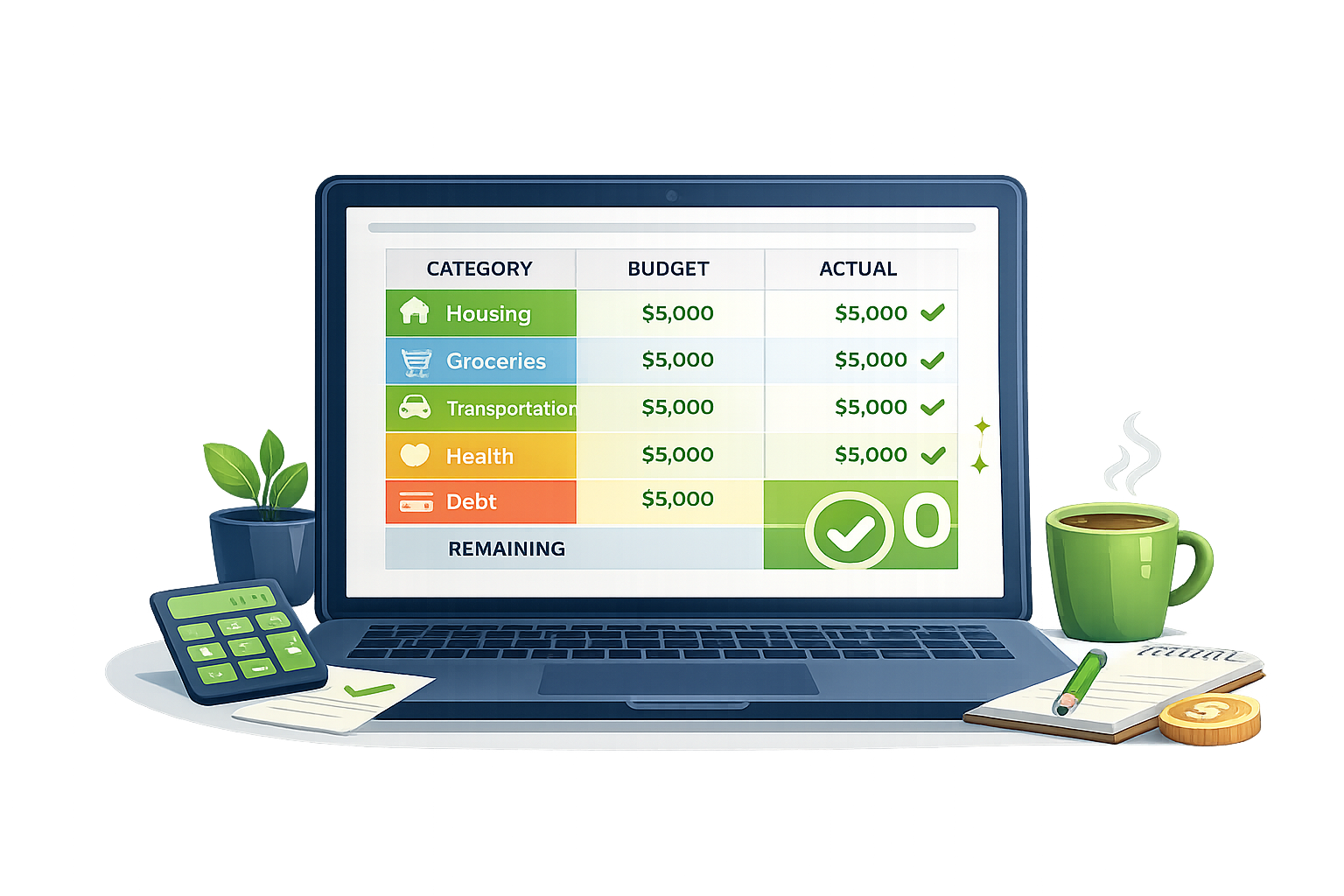
Zero-Based Budget Template: Free Download + How to Use It
Zero-based budgeting is the most effective budgeting system for people who are serious about paying off debt. The concept is simple: every dollar of income gets assigned a specific purpose before the month begins, so that income minus all assignments equals exactly zero. Nothing is left unaccounted for. Nothing disappears into vague “miscellaneous” spending.
This guide explains the system, gives you a ready-to-use template, and shows you exactly how to run your first zero-based budget month by month.
What Is Zero-Based Budgeting?
In a zero-based budget, your total income minus all budget categories equals zero. This doesn’t mean spending every dollar — saving and debt payments are categories too. It means every dollar is assigned a purpose in advance rather than spent reactively and tracked after the fact.
Traditional budgeting: spend money throughout the month, then track what happened. Zero-based budgeting: assign every dollar at the start of the month, then execute the plan. The difference sounds small but produces dramatically different outcomes.
The Zero-Based Budget Template
Use this template structure in a spreadsheet or on paper. Customize the categories for your life.
MONTHLY INCOME
Take-home pay (paycheck 1): $______
Take-home pay (paycheck 2): $______
Side income/freelance: $______
Other income: $______
TOTAL INCOME: $______
GIVING
Charitable giving: $______
SAVINGS
Emergency fund: $______
Retirement (if not auto-deducted): $______
Sinking funds (car repair, medical, etc.): $______
HOUSING
Rent/mortgage: $______
Electric: $______
Gas: $______
Water/trash: $______
Internet: $______
Phone: $______
FOOD
Groceries: $______
Restaurants/eating out: $______
TRANSPORTATION
Car payment: $______
Gas: $______
Car insurance: $______
Car maintenance/registration: $______
Public transit: $______
HEALTH
Health insurance (if not pre-deducted): $______
Prescriptions: $______
Doctor/dental copays (monthly average): $______
Gym membership: $______
PERSONAL
Clothing: $______
Haircuts/personal care: $______
Entertainment: $______
Streaming services: $______
Subscriptions: $______
DEBT PAYMENTS
Minimum payment — [Debt 1]: $______
Minimum payment — [Debt 2]: $______
Extra debt payment (attack debt): $______
TOTAL EXPENSES: $______
INCOME MINUS EXPENSES = $0 ← This is your goal
How to Run Your First Zero-Based Budget
Step 1: Track Last Month’s Spending First
Before you build your first budget, go through last month’s bank and credit card statements and categorize every transaction. This gives you a reality-based starting point rather than aspirational guesses. Most people are shocked by what they find in eating out, subscriptions, and impulse purchases.
Step 2: Build Next Month’s Budget on the 25th–31st
Build your budget before the month begins, not after. At the end of each month, sit down with your income projections for next month and assign every dollar. If you’re paid biweekly, use your lowest-income months as your baseline to avoid planning with money you might not have.
Step 3: Weekly Check-Ins
Spend 10–15 minutes every week updating your spending in each category. This prevents the “I forgot I spent $200 on Amazon this month” problem that derails most budgets. Awareness, not restriction, is what drives the behavior change.
Step 4: “Roll With the Punches”
When something unexpected happens — and it will — don’t abandon the budget. Move money from one category to another. If your car repair cost $300 more than your maintenance sinking fund, move $300 from entertainment or clothing. The budget is a plan, not a prison. Adjusting in real time is the skill.
Step 5: Maximize the Extra Debt Payment Line
The “extra debt payment” line is where your zero-based budget superpower lives. Once all essential categories are funded, everything left over goes here. As you find and eliminate budget waste, this number should grow month by month. Combine this with your chosen payoff method from our guide on the debt snowball vs avalanche, and use one of the best debt payoff apps to track your progress.
Common Zero-Based Budget Mistakes
- Forgetting irregular expenses — annual insurance renewals, holiday gifts, car registration. Divide annual amounts by 12 and include them as monthly sinking fund contributions
- Being unrealistically restrictive — a grocery budget of $200/month for a family of four will fail. Build realistic numbers or you’ll abandon the system
- Only budgeting once — the first budget is just a starting template. It takes 3 months of adjusting to get a budget that accurately reflects your actual life
- Not budgeting for fun — a budget with zero entertainment, dining out, or personal spending fails because it’s not sustainable. Small intentional fun spending is part of a good budget
Frequently Asked Questions
What if my income is variable (freelancer/self-employed)?
Budget based on your lowest realistic income month. When you earn more than budgeted, the surplus goes entirely to debt or savings — it doesn’t expand other categories. This naturally creates a buffer and accelerates debt payoff in high-income months without destabilizing low-income months.
Is zero-based budgeting the same as YNAB?
YNAB (You Need A Budget) is a popular app built around zero-based budgeting principles. The zero-based concept is the methodology; YNAB is one tool to implement it. You can zero-based budget effectively with a free spreadsheet, a piece of paper, or any budgeting app — YNAB is not required.
How long until I see results?
Most people who commit fully to a zero-based budget find their first significant extra payment money within 30–60 days. The full behavioral shift — where the budget feels natural rather than effortful — typically takes 3 months.