Debt Consolidation Loans: Pros, Cons & Best Options in 2026
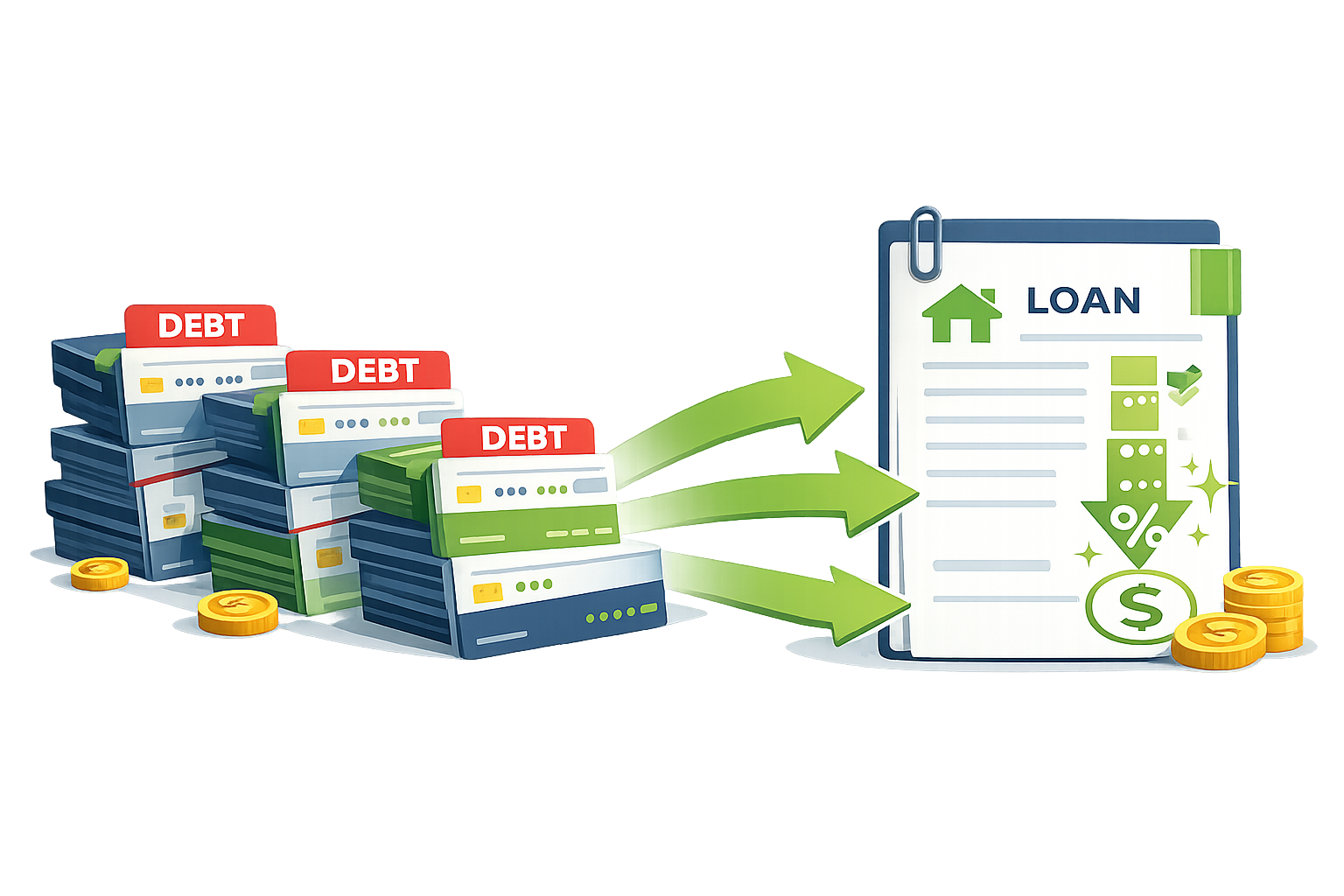
Debt consolidation combines multiple debts into a single loan — typically at a lower interest rate — to simplify payments and reduce total interest paid. When it works, it’s an elegant solution. When it’s used poorly, it can extend your debt timeline and cost more than doing nothing. This guide gives you everything you need to know to decide whether debt consolidation is right for your situation.
How Debt Consolidation Works
You take out a new loan (personal loan, home equity loan, or balance transfer credit card) and use the proceeds to pay off multiple existing debts. You’re left with a single monthly payment, ideally at a lower interest rate, instead of managing multiple payments to different creditors.
The Main Types of Debt Consolidation
1. Personal Loan Consolidation
Borrow a fixed amount at a fixed interest rate (typically 7–24% APR depending on your credit score) for a fixed term (24–84 months). Use the proceeds to pay off credit cards and other high-interest debts. Best for people with good to excellent credit who can qualify for rates significantly below their current debt rates.
2. Balance Transfer Credit Card
Transfer existing credit card balances to a new card offering 0% APR for an introductory period (typically 12–21 months). Pay zero interest during the promotional period. Best for people who can pay off the balance within the promotional period and qualify for a card with a sufficient credit limit. Transfer fees typically 3–5% of transferred balance.
3. Home Equity Loan / HELOC
Use the equity in your home to borrow at low rates (currently 7–9% APR). Rates are significantly lower than credit cards. Critical risk: your home is collateral. If you default, you can lose your house. Generally not recommended for consumer debt consolidation unless you have a very specific, high-discipline plan.
4. 401(k) Loan
Borrow from your own retirement account at a low rate. The interest you pay goes back to yourself. The risks: if you leave your job, the loan is due immediately; if you can’t repay, it becomes a taxable distribution plus 10% penalty. Generally not recommended.
Debt Consolidation: Pros
- Simplified payments: One payment instead of managing 5–8 different due dates
- Potentially lower interest rate: If you qualify for a good rate, you pay less total interest
- Fixed payoff timeline: Personal loans have defined end dates — you know exactly when you’ll be debt-free
- Improved cash flow: Lower monthly payment (though watch for extended terms that cost more over time)
- Credit score boost potential: Paying off credit cards improves your utilization ratio
Debt Consolidation: Cons
- Requires good credit to get good rates: People who need consolidation most often qualify for the worst rates
- Doesn’t fix the behavior: If you run up the cards again after consolidating, you’ve doubled your debt
- Extended terms cost more: A 7-year personal loan at 12% on $20,000 costs more total interest than a 3-year plan
- Fees add up: Origination fees (1–6% of loan amount), balance transfer fees (3–5%), closing costs for home equity
- Secured loans risk assets: Using home equity for consumer debt puts your house at risk
When Debt Consolidation Makes Sense
Consolidation is a good idea when: you can qualify for an interest rate at least 5 percentage points below your current average rate, you have the discipline to not accumulate new debt on the freed-up credit cards, you can afford the monthly payment without extending the term so long that savings disappear, and your credit is good enough to qualify for reasonable rates (typically 680+ FICO).
When Debt Consolidation Doesn’t Make Sense
Consolidation is the wrong choice when: your credit score is too low to qualify for a meaningfully better rate, your debts are primarily secured (mortgage, auto) rather than unsecured, you’ve tried consolidating before and ran the cards back up, or the total interest cost of the new loan is higher than your current trajectory. In these situations, a direct payoff approach using the debt snowball or avalanche method is more appropriate. If your debts are severely delinquent, explore debt settlement options reviewed in our National Debt Relief review.
Best Debt Consolidation Options in 2026
Best Personal Loans for Debt Consolidation:
- LightStream: 6.49–25.49% APR, no fees, $5,000–$100,000, excellent credit required (720+)
- SoFi: 8.99–29.99% APR, no origination fee, unemployment protection, $5,000–$100,000
- Discover: 7.99–24.99% APR, no origination fee, 36–84 month terms, 660+ credit
- Upstart: 7.80–35.99% APR, considers factors beyond credit score, good for thin credit files
Best Balance Transfer Cards:
- Citi Simplicity: 0% APR for 21 months, 3% transfer fee, no late fees
- Wells Fargo Reflect: 0% APR for up to 21 months, 5% transfer fee
- Chase Slate Edge: 0% APR for 18 months, 3% transfer fee
The Most Important Rule of Debt Consolidation
After consolidating, freeze or close the credit cards you paid off. Every person who has consolidated and then run the cards back up has ended up worse off. The consolidation loan is not a solution — it’s a tool. The solution is the behavioral change that prevents new debt while paying off the consolidated balance. Without that change, consolidation is just rearranging debt furniture.
Frequently Asked Questions
Does debt consolidation hurt your credit score?
Applying for a consolidation loan results in a hard inquiry (typically -5 points temporarily). Paying off multiple accounts improves your credit utilization ratio significantly, which often results in a net credit score increase within 1–3 months of consolidation.
Can I consolidate debt with bad credit?
Options narrow significantly with poor credit. Secured options (home equity) become more relevant if you own property. Some credit unions offer credit-builder loans. Nonprofit credit counseling debt management plans are also an option that doesn’t require good credit. See our guide to negotiating with creditors directly as an alternative.