
Debt Snowball vs Avalanche: Which Pays Off Debt Faster?
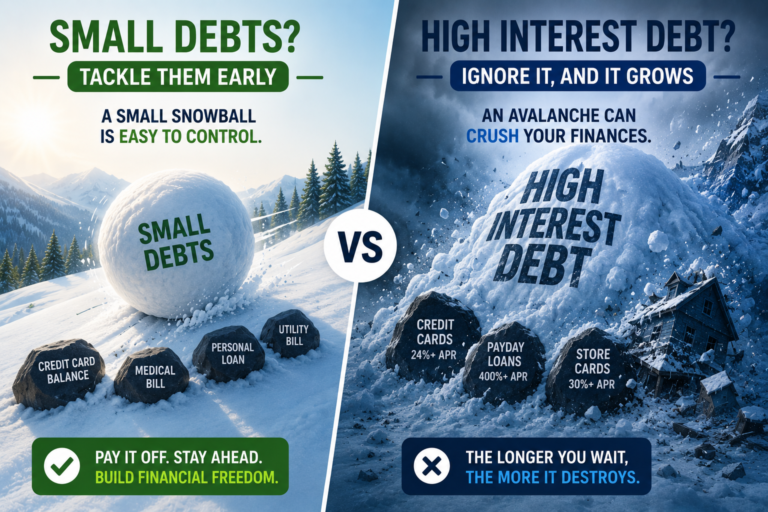
You’re ready to get serious about debt. You’ve heard about two approaches — the snowball and the avalanche — and you need to know which one is actually better. The answer isn’t the same for everyone. One maximizes motivation. One maximizes math. And research shows these two priorities lead to different real-world outcomes.
The Debt Snowball: How It Works
The debt snowball, popularized by Dave Ramsey, is simple: list all debts from smallest balance to largest, ignoring interest rates completely. Pay minimums on everything. Attack the smallest balance with every extra dollar. When it’s eliminated, roll that entire payment — minimum plus extra — to the next smallest. The payment amount grows or “snowballs” with each debt you eliminate.
Snowball Example
Debt list ordered for snowball:
1. Medical bill: $380 | 2. Store card: $1,200 | 3. Credit card: $4,500 | 4. Personal loan: $8,800 | 5. Car loan: $12,000
Extra payment available: $300/month
Month 1–2: Medical bill paid off. First win in 6 weeks.
Month 3–9: Roll $300 + former medical minimum to store card. Store card gone.
Month 10+: Now rolling a large payment at each subsequent debt. Momentum compounds.
The Debt Avalanche: How It Works
The debt avalanche focuses on interest rates. List all debts from highest interest rate to lowest. Pay minimums on everything. Attack the highest-rate debt with every extra dollar. When eliminated, roll that payment to the next highest rate. This method mathematically minimizes total interest paid over the life of your debt payoff.
Avalanche Example
Same debts ordered for avalanche by rate:
1. Store card 28% APR: $1,200 | 2. Credit card 24% APR: $4,500 | 3. Medical 0% APR: $380 | 4. Personal loan 15% APR: $8,800 | 5. Car loan 6.9% APR: $12,000
Extra payment available: $300/month
Month 1–4: Store card paid off first (happens to also be small). Similar speed in this case.
Month 5–18: Attack $4,500 credit card next. No new payoff win for 14 months. This is where many people lose motivation.
Head-to-Head Comparison
| Factor | Snowball | Avalanche |
|---|---|---|
| Order of attack | Smallest balance | Highest interest rate |
| Speed to first win | Fast (weeks to months) | Can take many months |
| Total interest saved | Good | Maximum |
| Psychological benefit | Very high | Moderate |
| Completion rate | Higher | Lower |
| Best for | Most people | Highly disciplined savers |
The Real Dollar Difference
On a typical $25,000 debt spread across five accounts with varying rates, the avalanche saves approximately $1,500–$3,000 more in interest compared to the snowball over the same payoff period. That’s real money. But the crucial question is: does the person actually finish? Harvard Business Review research found that people using the snowball method are measurably more likely to pay off their total debt — the behavioral advantage often outweighs the mathematical one.
Which Method Actually Pays Off Debt Faster?
In pure calendar time, the avalanche is technically faster because less interest accumulates. On a $25,000 debt load, the avalanche might finish 2–4 months ahead of the snowball if both are executed perfectly. But “executed perfectly” is the catch — the snowball’s higher completion rate means more people actually reach the finish line, making it effectively faster in the real world where human psychology matters.
The Hybrid Strategy: Best of Both
You don’t have to choose rigidly. Many successful debt payoff plans use a hybrid approach:
- If your smallest balance also has a high interest rate — snowball and avalanche agree. Attack it.
- If you have 1–2 tiny balances under $500 — knock those out first for momentum regardless of rate, then switch to pure avalanche
- If your highest-rate debt also has the largest balance — pay it down to match your next-largest balance, then reassess
Choosing Based on Your Personality
Choose Snowball if: You’ve tried to pay off debt before and quit. You need visible progress to stay engaged. You have several small balances cluttering your financial picture. Your debts have similar interest rates (within 3–4 percentage points).
Choose Avalanche if: You have strong financial discipline and stick to budgets religiously. You find the math savings more motivating than quick wins. Your highest-rate debt has a manageable balance. You’ve never given up on a long-term financial goal before.
Whatever you choose, see our guide on how to pay off $20,000 in debt for the complete system that works alongside either method.
Frequently Asked Questions
Can I switch methods mid-journey?
Yes, and many people do. Starting with snowball for early wins, then switching to avalanche once you have momentum, is a completely valid strategy. What matters is keeping the payments going, not which label you put on the method.
What if all my interest rates are similar?
If your rates are within 2–3 percentage points of each other, just use the snowball. The interest difference is minimal and the psychological benefit of quick wins is significant.
Does the method matter if I’m using debt consolidation?
If you consolidate multiple debts into one loan, the snowball/avalanche distinction applies to any remaining separate debts plus the consolidation loan. The consolidation itself doesn’t eliminate the need for a payoff strategy — it just potentially reduces your interest rate.
Final Thoughts
The best debt payoff method is the one you’ll actually stick with for 2–5 years. For most people, that means the snowball wins — not because it’s mathematically superior, but because finishing matters more than optimizing. Pick one, commit for 90 days, and let the momentum take over. The right method is the one that keeps you paying.
Pick Your Method — Then Track Every Payment
Use our free debt payoff tracker to stay on plan month after month.