Debt to Income Ratio: What It Is & How to Lower It6
Your debt-to-income ratio (DTI) is one of the most important numbers in your financial life — and most people don’t know what it is. Lenders use it to decide whether to approve your mortgage, auto loan, personal loan, or credit card application. A high DTI can block you from getting approved even with a decent credit score. Here’s everything you need to know about DTI and how to improve it.
What Is Debt-to-Income Ratio?
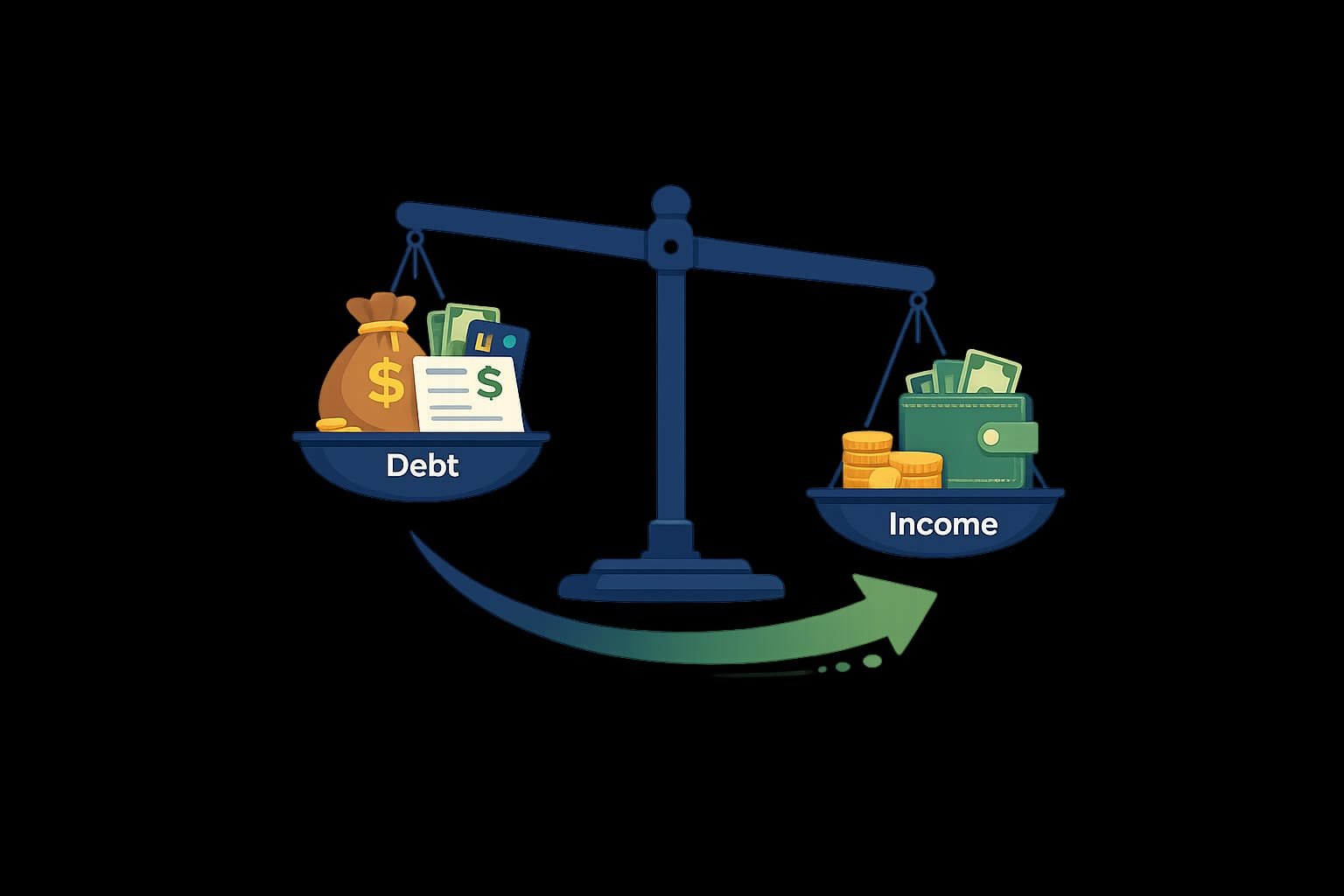
Your DTI ratio compares your total monthly debt payments to your gross monthly income (before taxes). It tells lenders how much of your income is already committed to existing debt obligations — and therefore how much risk they’re taking on by lending you more.
How to Calculate Your DTI Ratio
(Total Monthly Debt Payments ÷ Gross Monthly Income) × 100 = DTI%
Example:
Monthly debt payments: Credit card minimums $150 + Car payment $380 + Student loan $220 + Personal loan $175 = $925/month
Gross monthly income: $5,200/month
DTI = ($925 ÷ $5,200) × 100 = 17.8%
What to Include in Monthly Debt Payments
- All credit card minimum payments
- Car loan payments
- Student loan payments
- Personal loan payments
- Medical debt payments
- Any mortgage or rent payment
- Child support or alimony payments
Do NOT include: Utilities, groceries, insurance, subscriptions, phone bills, or any other non-debt expenses.
What Is a Good Debt-to-Income Ratio?
| DTI Range | What It Means | Lender View |
|---|---|---|
| Below 20% | Excellent | Very low risk — best rates |
| 20–35% | Good | Manageable — good approval odds |
| 36–43% | Acceptable | Approaching limit for most lenders |
| 44–49% | High | Difficult to get approved |
| 50%+ | Danger zone | Most lenders will not approve |
DTI Requirements for Common Loans
Mortgage Loans
Most conventional mortgage lenders want your DTI below 43%, though the preferred range is below 36%. FHA loans allow DTI up to 50% in some cases. Your “front-end DTI” (housing costs alone as a percentage of income) should ideally be below 28%.
Auto Loans
Auto lenders typically approve loans up to 50% DTI, but rates improve significantly below 36%.
Personal Loans
Most personal loan lenders want DTI below 40–45%. The best rates go to borrowers below 30%.
How to Lower Your DTI Ratio
There are only two levers: reduce debt payments or increase income. Here’s how to work both:
Reduce the Debt Side
- Pay off small debts entirely: Eliminating a $200/month car payment immediately drops your DTI by $200/month regardless of income. This is one of the fastest DTI improvements available
- Use the debt snowball: Focus on eliminating individual debts rather than spreading extra payments evenly — each payoff removes an entire payment from your DTI calculation
- Avoid new debt: Every new loan or credit card minimum payment adds to your DTI
- Refinance to lower payments: Refinancing a car or student loan to a lower monthly payment reduces DTI even if total cost increases — useful specifically for DTI purposes when preparing for a mortgage
See our comprehensive plan for how to pay off debt fast and our budget template to find extra payment money.
Increase the Income Side
- Ask for a raise (document your contributions, research market rates, time the ask strategically)
- Add a part-time income source — even $500/month increases gross monthly income by $500
- Add a co-borrower with income when applying for a mortgage
- Include all legitimate income sources: rental income, freelance income, investment income, alimony received
DTI vs Credit Score: Which Matters More?
Both matter, but they measure different things. Your credit score measures how reliably you’ve paid debt in the past. Your DTI measures how much of your current income is already committed. A high credit score with a high DTI can still result in loan denial. A lower credit score with an excellent DTI can still get approved with the right lender. For mortgage applications especially, get both numbers into good shape before applying.
Frequently Asked Questions
Does DTI affect my credit score?
DTI itself is not part of your credit score calculation. However, the debts that create a high DTI — especially high credit card balances — affect your credit utilization ratio, which is a major credit score factor. Paying down debt improves both your DTI and your credit score simultaneously.
How long does it take to improve DTI?
DTI can improve significantly within 6–18 months of focused debt payoff. Paying off a $5,000 credit card with a $150/month minimum immediately reduces monthly obligations by $150 — a tangible DTI improvement visible in any future loan application.
What if my DTI is 50%+ and I need a mortgage?
You’ll likely need to pay down debt before qualifying for a conventional mortgage. FHA loans offer more flexibility, and some non-QM lenders specialize in higher DTI borrowers. Working with a mortgage broker who can shop multiple lenders is valuable in this situation.
Calculate Your DTI and Build Your Improvement Plan
Free DTI calculator + personalized debt reduction roadmap.